db = FileAttachment("patterns/patterns.json").json()
P = db.patterns
kinds = new Map([["border", "Border band"], ["edging", "Narrow edging"], ["rosette", "Rosette / star"], ["motif", "Motif"], ["vertical band", "Vertical band"]])
hi = ({domain: [...kinds.values()], range: ["#10099F", "#2DD2C0", "#d61f69", "#FAC55B", "#FFA05F"]})
rows = P.map(p => ({...p, type: kinds.get(p.kind), group: p.frieze ?? p.point ?? "none"}))Explore the collection
The whole Sjónabók corpus at a glance: where the patterns come from, what shapes they take and how they are built. Click a bar or a dot to open the matching patterns in the gallery.
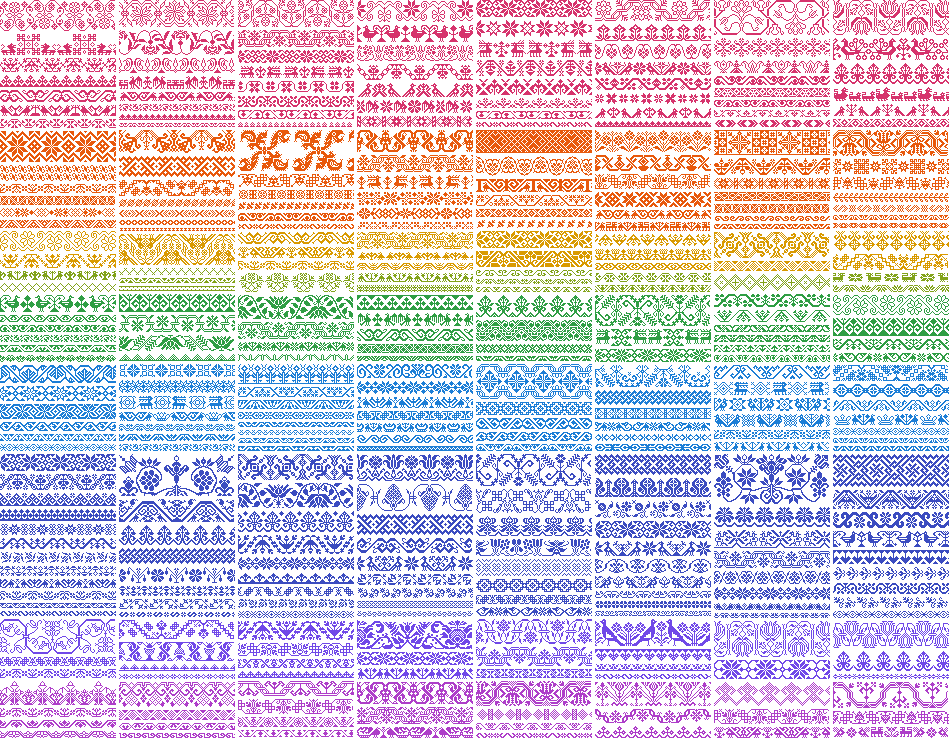
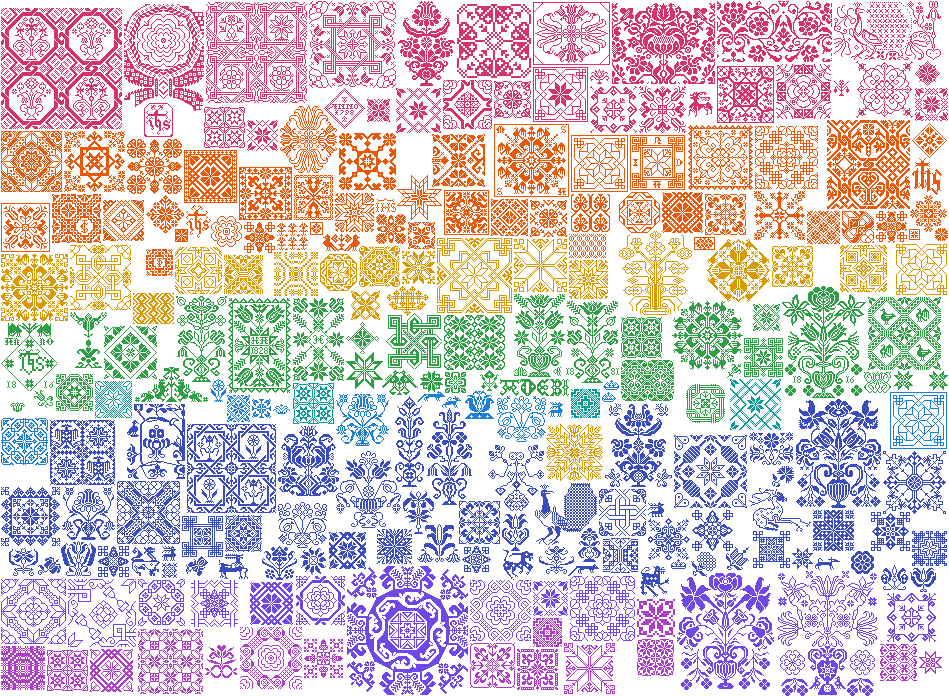
Every pattern on two sheets
Bands and motifs are shown apart, each packed tightly. Each colour is one source, in order from the top, so the colour changes run across the sheet. Click a source to open its patterns in the gallery, or a sheet to see it full size.
Bands
Motifs, rosettes and one-off bands
Where the manuscripts come from
The ten manuscripts behind the collection, on a timeline and a map of Iceland. Each book is marked by its own signature motif: a small figure that keeps coming back in that book and not much in the others. Tap an icon for who made or owned the book, when, how sure we are, and an example page in the gallery. The frame colour says how the place is tied to the book.
NoteHow the signature motifs are picked
Everything is done by an open script, so anyone can rerun it and get the same icons (gallery/map/signature_motifs.R, make motifs).
- Find small figures. In every chart, find each small figure, 5 to 11 cells on a side, with empty space around it (at most two stray cells touching it, so a flower on a short stem still counts).
- Count how often it recurs. For each figure, count the pages in the same manuscript where it, or a near copy, appears. A near copy may be turned or mirrored and may differ in up to 12% of its cells.
- Keep what belongs to that book. Drop figures that turn up more often in other manuscripts than in this one. Score = pages × share of pages in this book × log(1 + copies).
- Keep them distinct. The manuscript with the clearest favourite chooses first; each next one takes its best figure that differs from those already chosen in at least 45% of its cells.
A person checks the result: the script also draws a sheet of the six best candidates per manuscript, and a pick can be swapped by hand in gallery/map/picks.csv. Places and dates come from museum records (manuscripts.csv, places.csv); the map is drawn with R and leaflet (make map). Open questions about places are tracked in issue #15.
Do patterns travel?
The Icelandic manuscripts next to the printed pattern books of Germany, Italy and France. Pink lines join a book and a manuscript that hold the same figure; grey dashes are copying between books that the museums record. Read more on the About page.
Sources and types
Each file name starts with the manuscript or museum number it was taken from. Borders (long bands) dominate most sources; rosettes and figurative motifs cluster in a few.
Shape
Pattern width against height, after the empty margin is trimmed. Bands lie along the bottom, rosettes on the diagonal. Hover a dot for its name, click to open it.
Symmetry
Symmetry is measured automatically: a mirror or turn counts when at least % of the cells match. Bands are classified into the seven frieze groups, using one repeat of the band. Motifs and rosettes get a point group: D4 is the eightfold symmetry of a square star, D1 a single mirror, C1 none. What the codes mean, with pictures.
Repeats in the borders
How many cells wide one repeat of a border is. Short repeats are small running motifs; long repeats are large meanders. bands have no clear repeat within their length.
Density and floats
Density is the share of filled cells. The longest float is the longest run of filled cells in one row, which matters when a chart is knitted on a machine (long floats snag).
All measures come from gallery/scripts/build_gallery.py, which runs on every build. They describe the digitised charts and can be off where a chart was split or cleaned imperfectly.